Showing posts with label oracle. Show all posts

Wednesday, February 21, 2018

Using the Slack webhook API from PL/SQL

Slack is a web-based chat room popular with many companies. Slack also has an API that can be used to post messages to a given "channel" or chat room. The simplest API offered is the "webhook" integration, which is "a simple way to post messages from external sources into Slack. They make use of normal HTTP requests with a JSON payload that includes the message text and some options."


To create a new Slack webhook, login to Slack and go to "Apps" in the left sidebar menu. Click "Manage apps..." and click "Custom Integrations" and then "Incoming Webhooks". Click on "Add Configuration" to create a new webhook. Specify the channel the webhook will post in, and click "Add incoming webhooks integration".


Next, take a note of the Webhook URL:


Then go to the Alexandria PL/SQL Utility Library and install the SLACK_UTIL_PKG package in your database schema. Modify your database Network ACL settings to include "hooks.slack.com" (port 443) to allow connections to the Slack site from the database.

Then use the package like this (see also demo script):


In addition to application-specific messages you could perhaps also set up the database (via a background job) to notify you when you are about to run out of disk space, when the number of APEX page views reach a certain threshold, when a specific user logs in, and so on. Use your imagination! :-)


Wednesday, October 18, 2017

Oracle XE 12c becomes Oracle XE 18c

Oracle Database, Express Edition (XE) is a free version of the Oracle Database, currently available as version 11g (11.2) for Windows and Linux.
A planned new version of Oracle XE based on 12c (12.2) was first mentioned back in 2013. Now we are in 2017 and Oracle has changed its version numbering, aiming for yearly releases of the database, which means that after 12c comes 18c (in 2018) and 19c (in 2019) and so on.

According to information coming out at this year's Oracle OpenWorld, the next version of Oracle Database Express Edition (XE) will therefore be Oracle XE 18c.

Below are the details known so far about this upcoming version. Disclaimer: I've collected this information from tweets and blogs, so nothing is official yet. Time will tell as to what is true. UPDATE: Gerald Venzl from Oracle has confirmed the below to be "all true" :-)

  • The next version of Oracle Express Edition (XE) will be 18c. (Source: Chris Saxon, Twitter)
  • Oracle XE 18c is expected in Q1 of 2018. (Source: AMIS blog). UPDATE: Oracle XE 18c "is currently planned between March and August 2018 and might change". (Source: Gerald Venzl, Twitter)
  • There will be yearly releases of Oracle Express Edition (XE), ie Oracle XE 19c in 2019, etc. (Source: Franck Pachot, Twitter).
  • There will be simultaneous releases of XE for Linux and Windows. (Source: Gerald Venzl, Twitter)
  • Limits for XE 18c will be 2 GB of memory, 12GB of storage (with basic/advanced compression bringing real capacity up to around 40GB), 2 CPUs and 4 pluggable databases. (Source: AMIS blog and Lucas Jellema, Twitter)
  • Express Edition (XE) will actually include "nearly all" of the features from Enterprise Edition (EE)! (Source: Franck Pachot, Twitter and Chris Saxon, Twitter).
  • Express Edition (XE) will still be free for both development and production. (Source: Chris Saxon, Twitter).
  • There will be no support (except through community/forums) for XE, and no bug fixes/patches. Still, with a yearly release cycle that means bugs will be fixed by upgrading to the latest release. (Source: Franck Pachot and Bob Bryla, Twitter)


If most, or even some, of the above is true, this is really great news! I understand we should thank Gerald Venzl at Oracle for this, as he is the guy working on bringing us all this goodness! Thanks in advance, Gerald! :-)


Monday, October 9, 2017

ODC Appreciation Day: The PL/SQL Language

Like last year, Tim Hall of oracle-base.com fame suggested we should all do an "ODC Appreciation Day" in honor of the Oracle Developer Community (ODC), by blogging about our favorite Oracle product or feature.

My personal favorite, after the database itself, is the PL/SQL language that runs inside the database.


Here's what's great about it:
  • Simple (and therefore easy to understand and quick to learn)
  • Runs everywhere the Oracle database runs (any operating system)
  • Seamlessly integrated with SQL
  • Great performance, not least because it runs in the database server alongside your data, thus eliminating a lot of mid-tier overhead 

I made a presentation a while back that goes into greater detail about what makes PL/SQL great, take a look at PL/SQL: The Good Parts.


Thanks ODC!


Tuesday, March 21, 2017

Using VS Code for PL/SQL development

I've been using Sublime Text as my main editor for PL/SQL development for many years, but I'm now in the process of switching to Visual Studio Code (VS Code).


Some good reasons to use VS Code:
  • Multi-platform (Windows, OS X, Linux)
  • Free, open source
  • Lightweight, fast (enough)
  • Large ecosystem of extensions
  • Built-in Git support
  • Can be adapted to PL/SQL coding via a plsql language extension (syntax highlighting, go to/peek definition, go to symbol) and PL/SQL compilation using sqlplus via a Task Runner (see below for PL/SQL specifics)

Installing VS Code and extensions

Download VS Code from https://code.visualstudio.com/ and run the installer.

Start VS Code and click the Extensions icon.
  • Search for "plsql" and install the "xyz.plsql-language" extension
 The following are all optional but recommended:
  • Search for "git history" and install the "donjayamanne.githistory" extension
  • Search for "better merge" and install the "pprice.better-merge" extension (update 24.09.2017: this extension is now part of VS Code itself and does not need to be installed separately)
  • Search for "git lens" and install the "eamodio.gitlens" extension
  • Search for "tag" and install the "formulahendry.auto-close-tag" extension
  • Search for "blackboard" and install the "gerane.Theme-Blackboard" extension
  • Search for "material icon" and install the "PKief.material-icon-theme" extension
  • Search for "plsql" and install the "apng.orclapex-autocomplete" extension (added 02.01.2018)
Click on "Reload" to restart VS Code with the new extensions loaded.

Your list of extensions should now look something like this:


Click File, Preferences, Color Theme and select the "Blackboard" theme.
Click File, Preferences, File Icon Theme and select the "Material Icon" theme.

Configuring a Task Runner to compile PL/SQL code

Click File, Open Folder and open a folder containing your PL/SQL code.
Click View, Command Palette and enter "task" then select "Configure Task Runner", select "Others".

Copy the following text and paste it into the tasks.json file:


Adjust the connection string as appropriate to your environment.

Copy the following text and save it as _show_errors.sql in the project root folder:


Linux and Mac: Copy the following text and save it as _run_sqlplus.sh in the project root folder (remember to chmod +x the file to make it executable).


Windows: Copy the following text and save it as _run_sqlplus.bat in the project root folder.


Optionally create a login.sql file in project root folder and add:


Editing code

The PL/SQL language extension by xyz provides syntax highlighting for PL/SQL, as well as a couple of very useful code navigation features.

You can go to a "symbol" (ie a function or procedure) inside a package by pressing Shift+Ctrl+O and typing the name of the symbol:


You can go to the definition of a function or procedure by pressing F12 when the cursor is on the function or procedure name (or right-click on the function or procedure name and select either "Go to definition", or "Peek definition" to see the definition in a popup window without leaving the current file).


Snippets

You can define your own snippets for frequently used code; see this how-to article. I recommend that you create snippets for frequently used code blocks such as if/then/else statements, case statements, and larger code blocks such as the skeleton for a package, procedure or function.

Building code

To build (compile) the current file into the database, press Shift+Ctrl+B (or click View, Command Palette, and type "build" to search for the relevant command).

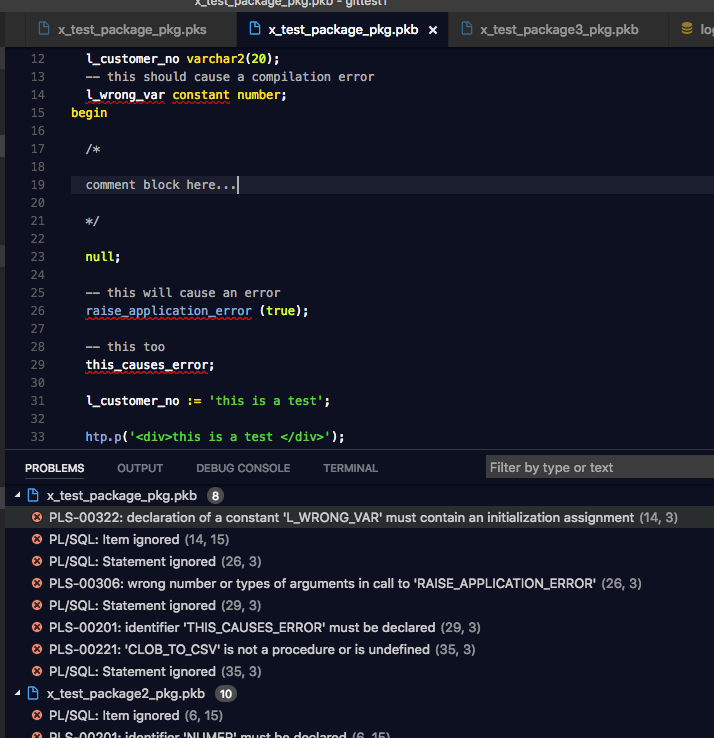
The build task runs sqlplus and passes it the filename of the current file. This creates or replaces the object in the database (you can see the commands being executed in the "Output" pane in VS Code). The build task then queries user_errors to get any errors and warnings from the database, and these are shown in the "Problems" pane in VS Code.


You can click on each problem to jump to the relevant line of code. You'll also see squiggly lines under the errors in the code itself, and you can hover over the text to see a tooltip containing the error message.

Note that since the build task queries the user_errors view without any filters, you get to see all errors in the schema, not just the errors for the current file. I actually like this, because it instantly shows me if there are any other problems in the schema that I might not otherwise be aware of.

Also, the build task assumes that you have one file per database object (ie separate files for package specifications and package bodies), and that the filenames match the database object names. This makes sense to me and I assume that's how most people organize their files, but you can tweak the _show_errors.sql script to generate output appropriate to your setup.


Version control with Git

VS Code has great built-in support for Git. I recommend installing a couple of git-related extensions (see above), but other than that, I'll just refer you to the official tutorial for using Git in VS Code.


That's it, enjoy using VS Code for PL/SQL development! :-)


Sunday, June 19, 2016

Blog retrospective

Not long ago I suddenly realized I had published my 100th blog post, so I figure it's time to look back and write down some thoughts about the blog.

I started this blog in 2008, so it has taken me all of 8 years to produce one hundred posts. Not exactly a huge output when compared to many other bloggers, but at least the pace has been reasonably consistent over the years, and hopefully most of the posts have been useful. So why am I bothering with blogging at all? Primarily, it's a good way to document and have easy access to information that I find useful in my own work, but I also want to contribute to the community and help other people be successful in their work.

Back in 2008, I had been working with Oracle and PL/SQL for about 10 years already, but was just getting started with APEX. One of my first posts shows that we are on APEX 3.1 and we are getting to grips with the differences between DBMS_EPG and mod_plsql. It seems that none other than Joel Kallmann himself was the first ever to post a comment on my blog, what a flying start! :-) (And by the way, it was Joel who told me just last year that one is supposed to write "APEX" in uppercase, not "Apex" like I have done for the first 7 years on this blog...! As you can see, I'm now firmly in the uppercase APEX camp... :-)

I have always been a believer in the "fat database" paradigm and in 2009, I wrote some posts about it. The same year, I released my open source project, the Thoth Gateway, a replacement for mod_plsql that is written in C# and runs on Microsoft Internet Information Server (IIS) as an ASP.NET web application. To create it, I had to dive deep into the internals of the PL/SQL Web Toolkit (OWA). It's really interesting to see all the amazing stuff in APEX that has been built on top of the rather humble foundations of OWA.

In 2010, I started looking into the use of JSON from PL/SQL, and I also published some utilities to parse CSV and return it via a pipelined function. I've had lots of use for that in the years after.

2011 was another productive year, as I launched the PL/SQL Utility Library, soon codenamed Alexandria. (With names like Thoth Gateway and Alexandria Library, it's no big secret that I enjoy studying ancient Egyptian history!) Another important milestone in 2011 was the PL/SQL API for Amazon S3, another package that I have had good use of a number of times since then.

In 2012 I released a PL/SQL API for MS Exchange, which was fun to write but I actually haven't had much use for this myself so far.

In 2013 the most popular post was the one about Oracle 12c XE, or rather the first mentions of this as-yet mythical creature. Based on the hints dropped by Oracle, this will be released some time after Oracle 12.2, so I believe it's still a couple of years to wait.

In 2014 I looked into the JSON capabilities of APEX 5.0, and I also updated the Thoth Gateway to use the ODP.NET Managed Driver to simplify installation.

In 2015, I wrote a four-part series on how to install Oracle XE, ORDS and APEX on Linux. As well as learning myself a lot about Linux, I think it helped a lot of people judging by the great feedback I got on this series.

I'll finish this retrospective with a look at some statistics. For some reason, Blogger only has statistics going back to May 2010, even though I started by blog in March 2008. Anyway, below is a chart showing the page views per month. It shows a slow rise from a couple of thousand page views per month, up to the current average which is about 20,000 page views per month.


 But look at the anomaly in the chart: In August 2011, it shows 18,000 page views! And what's more, those 18,000 page views were in a single day, not a total for the month! So what happened back then? At the end of July, I wrote a post called "Mythbusters: Stored Procedures Edition". It was my attempt to refute all the usual arguments for why "stored procedures are bad", which is what every Java/.NET developer tries to convince you (and yet they struggle mightily with their ORMs). My post caused a heated debate on the blog itself, and also on Hacker News and on Reddit. I guess we could have the same discussion all over again today. But instead of arguing, let's just go out there and build some kick-ass web applications with PL/SQL and APEX. "The proof of the pudding is in the eating", after all! :-)


Friday, December 18, 2015

My Oracle Database Developer Choice Awards 2015


Earlier this week, Santa's little helper (ie DHL) knocked on my door and delivered a package containing my trophies from the Oracle Database Developer Choice Awards 2015. I was nominated in three categories, and won awards in two of them: Application Express and ORDS.


Here's a video from the award ceremony at Oracle OpenWorld 2015:


I'd like to send a big THANK YOU to everyone who voted for me, and also to Oracle for organizing the awards and handing out such cool trophies! :-)


Monday, September 21, 2015

My nominations for the Oracle Database Developer Choice Awards 2015


I'm honored to have been nominated for the Oracle Database Developer Choice Awards 2015, in no less than three (!) categories: PL/SQL, Application Express (Apex) and Oracle REST Data Services (ORDS).


Here's a short video that explains what the Oracle Database Developer Choice Awards are all about:

If you are a regular reader of my blog, you are probably familiar with my contributions to the Oracle Database Developer community, but here is a short recap of my work in the relevant categories:

  • PL/SQL: I've been programming in PL/SQL for almost 20 years. I've written and released as open source the widely-acclaimed Alexandria PL/SQL Utility Library, which contains around 50 PL/SQL packages that deal with everything from general math and string utilities to Amazon web service integration, NTLM authentication, CSV parsing, MS Exchange integration, and much more. Jeffrey Kemp has a great guided tour of the library which highlights some of the packages. As of February 2015, the library had been downloaded more than 12,000 times. Furthermore, I've created a presentation called PL/SQL: The Good Parts, which in Steven Feuerstein's words is a "fast, entertaining high-level glimpse of what makes PL/SQL so great" (and Steven should know what he's talking about! :-).
  • Apex: Since 2008 I've published numerous articles related to Oracle Application Express on this blog. Among other things, I've created popular Apex plugins, including a pivot table plugin and a plugin for generating on-demand dynamic PL/SQL content. I've created and open-sourced the jQGrid Integration Kit for PL/SQL. And I created ApexGen, a framework for generating Apex apps using PL/SQL code (which I may revisit and enhance in the future if the Apex team provides a supported API for it). I've also been active in the Apex community by asking and answering questions on the Apex forum on OTN, actively testing Apex early adopter (EA) releases for Apex 4 and 5, and reporting numerous technical issues and bugs back to the Apex development team. My coworkers know me as "the Apex guy" since I constantly promote the virtues of Apex for new development projects.
  • ORDS: I've long been interested in the technology that connects the Oracle Database to the web, including the PL/SQL Web Toolkit (aka OWA) and the forerunners of ORDS such as mod_plsql and the Embedded PL/SQL Gateway. Using this knowledge I implemented and released as open source a mod_plsql alternative for Microsoft Internet Information Server (IIS) called the Thoth Gateway. I've published many articles on the use of JSON from PL/SQL, a key part of REST. Earlier this year I wrote a four-part blog post series with all the nitty-gritty details on installing and running Apex with ORDS that became very popular and widely distributed.

Now go and vote for me! :-)


Click here to vote in the PL/SQL category, here to vote in the Apex category, and here to vote in the ORDS category.

Thank you very much for your vote! :-)

Image credit.

Thursday, July 30, 2015

PL/SQL: The Good Parts

Somewhat inspired by Douglas Crockford's Javascript: The Good Parts presentation (and book), I have created a presentation called PL/SQL: The Good Parts.

This is not intended as an introduction to PL/SQL, but rather an overview of features you should consider if you want to maximize your enjoyment of programming in the Oracle Database. Also, this is not an exhaustive list of all features, it's simply the ones I personally use frequently.


Note that unlike Javascript, I don't consider PL/SQL to have too many "bad parts" or bizarre quirks. There's a lot of good stuff, hence the title! :-)

Click here to view the presentation.


Tuesday, July 7, 2015

Longer names coming to Oracle?

Have you ever, like me, been silently finger-counting the number of characters in a table name, column name or procedure name that you are about to create in the Oracle Database, to make sure it is short enough? It appears those days will soon (?) be at an end...

The current limit on names (identifiers such as table names, column names, procedure names, parameter names, etc) in Oracle SQL and PL/SQL is 30 characters. Here is what you see when you do a describe of the the user_tab_columns dictionary view in Oracle 11g:


But what do we see if we do the same on an Oracle 12c database? The database on apex.oracle.com was upgraded to 12c some time ago, so let's try the same there:


Interesting...! Looks like the new limit will be 128 characters. All the relevant views such as user_arguments, user_identifiers and user_objects have been likewise altered.

Mind you, as of version 12.1.0.2.0, it's still not possible to actually create objects with long names:


But it appears that the preparations have been done to allow longer names, so I'm guessing this will become possible in the next version (12.2?).

The world moves forward... it will be great to stop worrying about short names (but let's not go crazy and turn our PL/SQL into the equivalent of this silliness !).


Friday, February 14, 2014

Oracle on Windows Azure pricing revealed

I just noticed that prices for Oracle Database running on Windows Azure have now been published.


The prices for the virtual machines with the Oracle license included run from about USD 820 per month for Oracle Standard Edition (SE) running on 2 cores, to a whopping USD 9300 per month for Oracle Enterprise Edition (EE) running on 8 cores. These prices are for Oracle software only and do not include the cost of the VM, which is billed separately.

Alternatively, with "License Mobility", you obtain a license as normal from Oracle and run that software on Windows Azure by deploying a Windows Server or Linux VM and installing a copy of the licensed Oracle software. Azure is listed as an "Authorized Cloud Environment" in the Oracle Cloud Licensing Policy. As I understand it, this policy allows you to use Oracle Standard Edition One (SE1) on Azure (up to 4 cores = 1 processor license, up to 8 cores = 2 processor licenses), which would be a quite cheap entry-level option for small businesses, since you would pay once for a perpetual database license, and then just pay monthly for the Azure VM (ie just the Windows/Linux Server software, not the database).

There's also an article at ZDNet with more details.


Wednesday, March 7, 2012

ROWID: "this dreadful identifier"

Today I'm taking a look at the core packages of the PL/SQL language, namely the STANDARD and DBMS_STANDARD packages in the SYS schema. These packages contain a lot of the language features we use every day in PL/SQL programming.

These two packages are special in that you do not need to qualify the name of functions, procedures and constants in these packages with the package name. For example, SYSDATE and USER and DECODE and so on are declared in the STANDARD package, but you can use it without having to specify STANDARD.SYSDATE or STANDARD.USER or STANDARD.DECODE (which would get a bit tedious after a while...).

But enough lecturing! This post is really about the fun and/or weird stuff found in the comments of the STANDARD package.

You can have a peek at the package specification yourself by running the following query:


select text
from all_source
where owner = 'SYS'
and name = 'STANDARD'
and type = 'PACKAGE'
order by line


I'm using Oracle 10g XE to run this, the code and comments may obviously be different in other versions.

"PRIOR is WEIRD"

Line 700:


  -- PRIOR is WEIRD - For now, it will be treated as a function call.
  -- Does the function only take a column name?  how about its use in
  -- a predicate?
  function 'PRIOR'(colname VARCHAR2 CHARACTER SET ANY_CS)
          return VARCHAR2 CHARACTER SET colname%CHARSET;
      pragma FIPSFLAG('PRIOR', 1452);


As programmers, I guess we all leave some questions in our code, but I am a bit concerned to find questions like this in production code in the core package of the database...

"ROWID: this dreadful identifier"

Line 863:

  -- ROWID: this dreadful identifier is supposed to represent a datatype
  -- outside of SQL and and a pseudo-column (function, to us) when inside
  -- a sql statement.  ADA data model doesn't allow for any
  -- function X return X;
  -- so we must special case this.  Yuk.  There's special-case code in ph2nre
  -- which maps "rowid" to "rowid " if we're inside a SQL stmt.
  function "ROWID " return ROWID;
    pragma builtin('ROWID ', 1, 209, 240);  -- this had better never be called.


Yeah, yuk, nobody likes to special case stuff.

And remember: This had better never be called...! :-)

Who is JEM?

Line 978:

  -- Next two added for NLS 6/3/92 JEM.
  function TO_CHAR(left date, format varchar2, parms varchar2) return varchar2;
  function TO_CHAR(left number, format varchar2, parms varchar2)
    return varchar2;

This just reminds us that PL/SQL has been around for a long time; it's 20 years since this comment was added to the code (1992). That's kind of cool. Does anybody know who JEM is, and if he/she still works at Oracle?


"Under development"

Line 1483:

  --## Support for ANSI datetime data types is under development.
  --## The following operations, as well as the related types and
  --## operations defined above in the 8.1.5 section, are not yet
  --## available for use and are still subject to change.


I'm looking at version 10.2 (XE) and I see comments related to work under development in version 8.1.6. Was this ever finished?

"Should there be a pragma?"

Line 3088:

  -- Should there be a 8.2 new names pragma ?

I don't know. Since there was never a version 8.2 I guess the question is now moot.


Oracle 10i ?

Line 3132:

  -- 10i Binary Floating-point Built-in Functions

Looks like Oracle version 10 was intended to be called 10i (for "internet"), like its predecessors 8i and 9i. As we all know, it was called 10g (for "grid") instead, just like 11g.

Rumor has it the next version will be called 12c (for "cloud"). Ironic, since Larry himself called cloud "just water vapor" a few years back. The marketing guys are to blame, I guess.


"Ref Cursor has problems"

Line 3242:

--  Ref Cursor has problems. The MOVCR instruction needs more information than
--  the other MOV* instructions, including the PVM register of the destination
--  This cannot be easily supplied through the generic NVL instruction, so
--  for now, this flavor will continue to have a real body
--  PRAGMA interface(c,nvl,"pes_dummy",9);       -- Ref Cursor

I won't pretend to understand any of that, except the fact that the Ref Cursor has some kind of problem. Despite this, it's doing a pretty good job in my PL/SQL programs.


We are at the end of the package specification, but for some reason the package body is not wrapped (obfuscated) like most other package bodies in the SYS schema. So we can continue reading...

"The old 'select from dual' thing"

Line 62:

  -- Special: if the ICD raises ICD_UNABLE_TO_COMPUTE, that means we should do
  -- the old 'select soundex(...) from dual;' thing.  This allows us to do the
  -- SELECT from PL/SQL rather than having to do it from C (within the ICD.)
  function SOUNDEX(ch VARCHAR2 CHARACTER SET ANY_CS)
        return VARCHAR2 CHARACTER SET ch%CHARSET is
    c VARCHAR2(2000) CHARACTER SET ch%CHARSET;

Sounds like a good idea.

"Perhaps more intelligently in the future"

Line 109:

-- Just call the other to_char with a null format string.
-- Perhaps this can be done more intelligently in the future. JEM 3/14/90.
--  function TO_CHAR(LEFT NUMBER)        return varchar2 is
--  begin
--    return TO_CHAR(LEFT, '');
--  end TO_CHAR;

There's JEM again. This time the comment is even older (22 years ago!). As the whole block of code is now commented out, I guess they already found "a more intelligent way" to do it.


"Why do we need these?"

Line 371:

-- why do we need these dummy bodies for LEVEL and ROWNUM?

  function LEVEL return NUMBER is
        begin return 0.0; end;

  function ROWNUM return NUMBER is
        begin return 0.0; end;

Don't ask me...!


That's it, we're at the end of the STANDARD package. The DBMS_STANDARD package is much shorter and does not really contain any interesting comments. But I'm sure there are other packages in the SYS schema that contain some other gold nuggets -- can you find them?


Tuesday, June 16, 2009

The Fat Database (or Thick Database) Approach

I'm a big believer in the so-called "Fat Database" paradigm for data-centric business applications.


I think I first heard the term "Thick Database" in a presentation by Dr. Paul Dorsey at the ODTUG conference in 2007.
I prefer the slightly more hip term "Fat Database", and offer my own definition of the term:


"Building applications using the Fat Database approach means leveraging the full potential of the database engine and its features, rather than treating the database as a bit bucket. If a problem can be solved using the database, it should be solved using the database, rather than in a programming language outside the database."


In other words, the exact opposite of the current trend, which is to avoid any database feature except basic tables. The enterprise architecture astronauts would rather reinvent the wheel over and over again, using the latest silver bullet in the endless stream of "new and improved" languages and frameworks that appear (and disappear) every few years.
Benefits of the Fat Database approach include reduced cost and complexity, increased performance, and a degree of immunity against the need to constantly rewrite code in a rapidly changing technology landscape.

Here is a collection of links to presentations and papers related to the Fat Database approach:

Dr. Paul Dorsey, co-author of seven Oracle Press books on Designer, Database Design, Developer, and JDeveloper

Toon Koppelaars, co-author of Applied Mathematics for Database Professionals


Others

I will return to this subject in future postings on this blog.

Wednesday, June 10, 2009

The Oracle Database as Development Platform

There is really a lot of amazing stuff that you can do using just the Oracle database and PL/SQL these days. I've made this diagram to illustrate the Oracle database developer's toolbox (click image to enlarge):


Note that this is all native functionality in the database itself, it does not include anything from the Oracle Fusion (Java) technology stack (except JDeveloper, which is free and can be used for general database and web development, not just Java).